
News

News
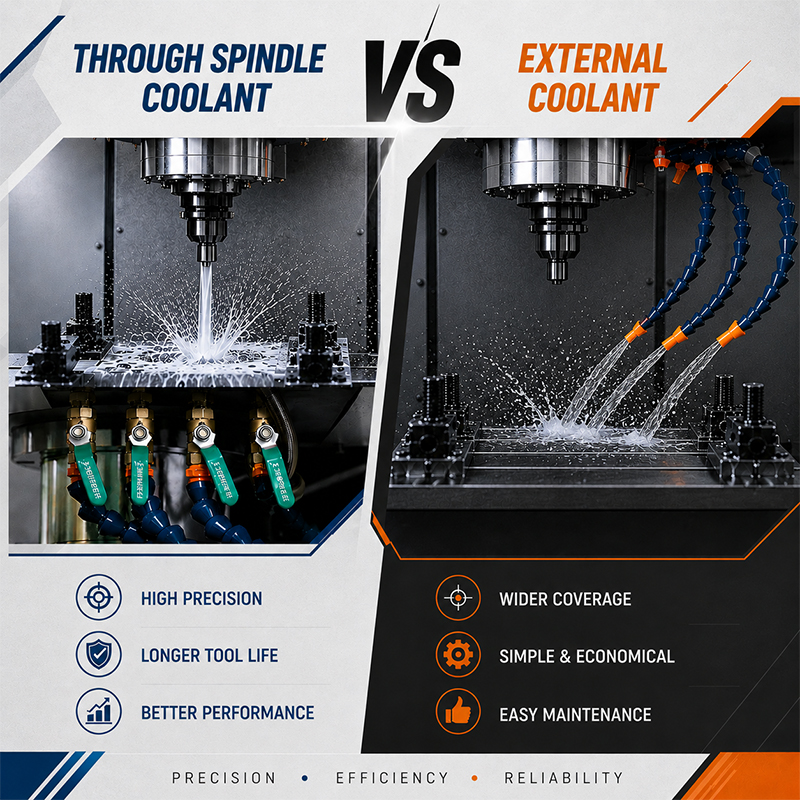
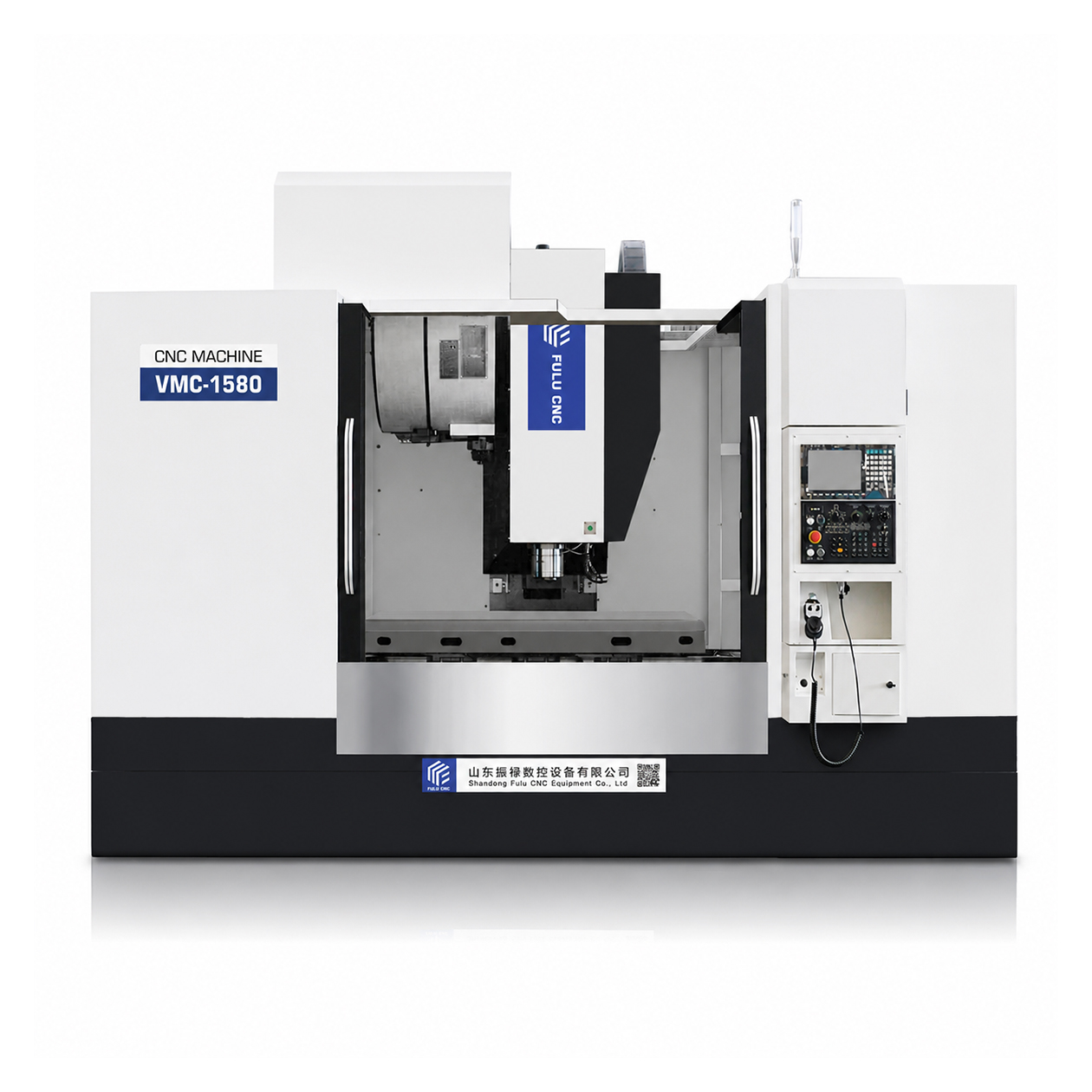
In modern CNC machining processes, the cooling system not only affects tool life but also directly impacts machining efficiency, workpiece surface quality, and production costs. Currently, through-spindle coolant and external cooling are the two most common cooling methods for vertical machining centers. Many customers inquire when purchasingVMC850VMC1160, VMC1275, VMC1580, and other machining centers, "What is the difference between through-spindle coolant and external cooling? Which one is more suitable for my machining needs?"
In fact, both cooling methods have their advantages, and there is no absolute superiority. The key lies in the machining material, process, and company budget. This article will provide a detailed comparison from multiple aspects such as working principle, machining effect, applicable industries, and cost investment to help you choose the more suitable cooling solution.
Through-spindle coolant, also known as spindle center coolant, delivers coolant through a high-pressure pump into the spindle interior, then sprays directly through the tool’s center hole to the cutting area.Unlike traditional external spraying, through-spindle coolant allows the coolant to reach the tool tip directly, maintaining continuous and stable cooling even during deep hole drilling or complex cavity machining.Currently, many high-end vertical machining centers are equipped with 30Bar, 50Bar, or even 70Bar high-pressure through-spindle coolant systems to improve machining efficiency and tool life.


External cooling is the most traditional and widely used cooling method. Coolant is sprayed externally onto the machining area through nozzles installed around the spindle or inside themachining centerThe external cooling system has a simple structure, low cost, and easy maintenance, making it the standard configuration for the vast majority of ordinary machining centers. For general milling, surface machining, and shallow hole machining, external cooling fully meets daily production needs.

The biggest difference between the two cooling methods lies in the position where the coolant reaches the tool.
Internal coolant supply delivers coolant directly to the center of the tool through the spindle, allowing the coolant to precisely act on the cutting point.
External cooling relies on external nozzles to spray coolant, and the spray direction is affected by the tool position, workpiece shape, and cutting angle.
Therefore, in general machining, the difference between the two is not obvious; however, in deep hole drilling, high-speed machining, and complex cavity machining, internal coolant supply shows more significant advantages.
1. More precise cooling
Since the coolant acts directly on the tool tip, it can quickly remove cutting heat and reduce the tool temperature.
Even when machining deep holes, it ensures continuous coolant flow into the machining area.
2. Increased tool life
During machining, the lower the tool temperature, the slower the wear rate.
Internal coolant supply effectively reduces thermal wear and chipping of the tool, extending tool life and thereby reducing tool costs.
This is especially important for carbide tools and high-speed machining.
3. Improve machining efficiency
Due to the reduced cutting temperature, cutting speed and feed rate can be appropriately increased.
Especially during continuous machining processes, the equipment can maintain a stable machining state and reduce downtime for tool changes.
For batch production enterprises, overall productivity can be significantly improved.
4. Stronger chip evacuation capability
High-pressure coolant not only cools but also promptly flushes chips out of the machining area.
This is particularly effective in deep hole drilling, tapping, and blind hole machining to prevent chip clogging and tool breakage.
5. More suitable for automated machining
With the development of unmanned machining, more and more companies are adopting automatic tool changers and automated production lines.
Center water supply can reduce manual chip cleaning and improve the stability of automated production.
Although the advantage of internal coolant supply is obvious, external cooling also has many irreplaceable features.
External cooling does not require high-pressure internal coolant supply devices, nor special tool holders and internal coolant tools.
The equipment procurement cost is lower, making it suitable for companies with limited budgets.
The entire cooling system has a simple structure.
Nozzles are easy to clean when clogged, and replacement parts are low cost.
Daily maintenance workload is relatively small.
For ordinary face milling, contour machining, slotting, and other processes, external cooling can fully meet machining requirements.
If the machining depth is not large, the difference in machining effects between the two cooling methods is not particularly significant.
The vast majority of ordinary vertical machining centers, engraving and milling machines, and drilling and tapping centers use external cooling systems.
When machining ordinary parts such as steel, aluminum, and cast iron, a good cooling effect can be achieved.
If the company mainly performs the following machining:
Deep hole drilling
High-speed drilling
Mold deep cavity machining
Stainless steel machining
Titanium alloy machining
High-temperature alloy machining
Large-scale automated production
It is recommended to prioritize the selection of a center water outlet system.
If the enterprise mainly engages in:
General parts machining
Surface milling
Slotting processing
Aluminum parts processing
General steel parts processing
Small batch processing
Choosing an external cooling system can meet production needs while effectively controlling equipment procurement costs.

The common central water outlet pressures on the market currently include:
30Bar: Suitable for general drilling and milling, it is the common configuration for most manufacturing enterprises.
50Bar: Stronger chip removal capability, suitable for deeper hole processing and continuous batch production.
70Bar: Mainly used in high-end processing industries such as aerospace, automotive parts, and precision molds, capable of meeting higher efficiency and higher precision processing requirements.
FULUCNC vertical machining centers can provide different coolant supply options such as 30Bar, 50Bar, and 70Bar according to the actual processing needs of customers, meeting the applications of various industries.
When selecting, companies can comprehensively consider the following aspects:
Processing materials: Ordinary steel and aluminum parts can choose external cooling; stainless steel, high-temperature alloys, and other difficult-to-machine materials are more suitable for through-spindle coolant.
Processing technology: Shallow holes and surface machining are suitable for external cooling; deep holes, blind holes, and complex cavities are recommended to use through-spindle coolant.
Production efficiency: For mass production and automated production, it is recommended to configure through-spindle coolant to improve production efficiency and reduce tool wear.
Procurement budget: If the budget is limited, external cooling offers higher cost-effectiveness; if pursuing long-term production efficiency and processing quality, through-spindle coolant is more worthwhile to invest in.
As a professional CNC machining center manufacturer, FULUCNC can provide various cooling configurations based on customer processing requirements, including standard external cooling systems and high-pressure through-spindle coolant systems of 30Bar, 50Bar, and 70Bar.
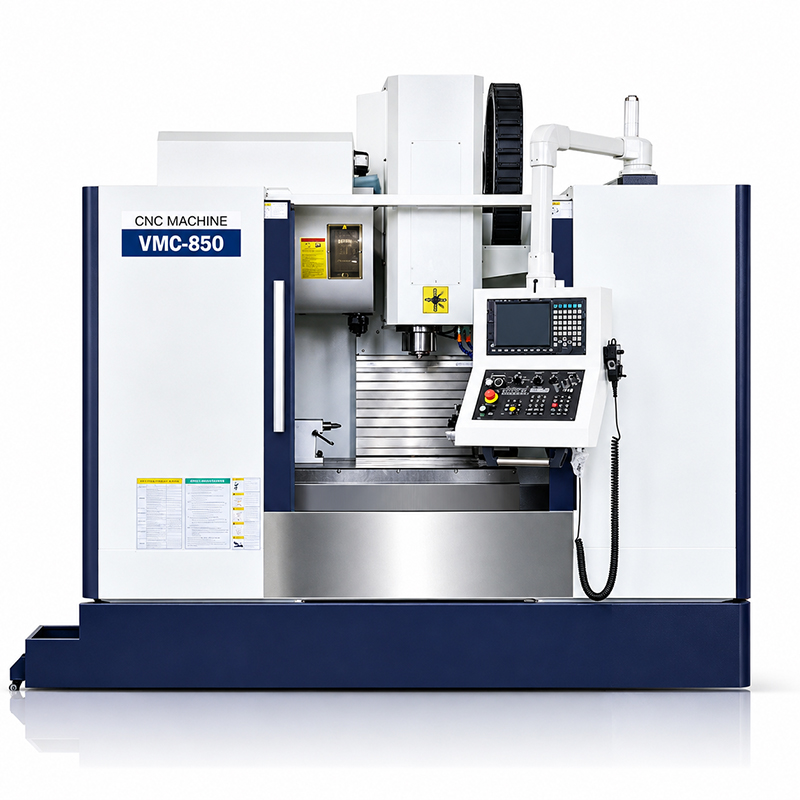
Our vertical machining centers such as VMC850, VMC855, VMC1160, VMC1275, and VMC1580 support customization of different cooling solutions and can recommend the most suitable equipment configuration based on customer processing materials, product types, and budgets.
If you are selecting a vertical machining center and are unsure whether through-spindle coolant or external cooling is more suitable for your production, please contact the FULUCNC technical team. We will provide professional advice based on your processing needs and develop a more cost-effective CNC machining solution for you.


Plsease input value
Plsease input value
Plsease input value
Plsease input value
Plsease input value
