
News

News
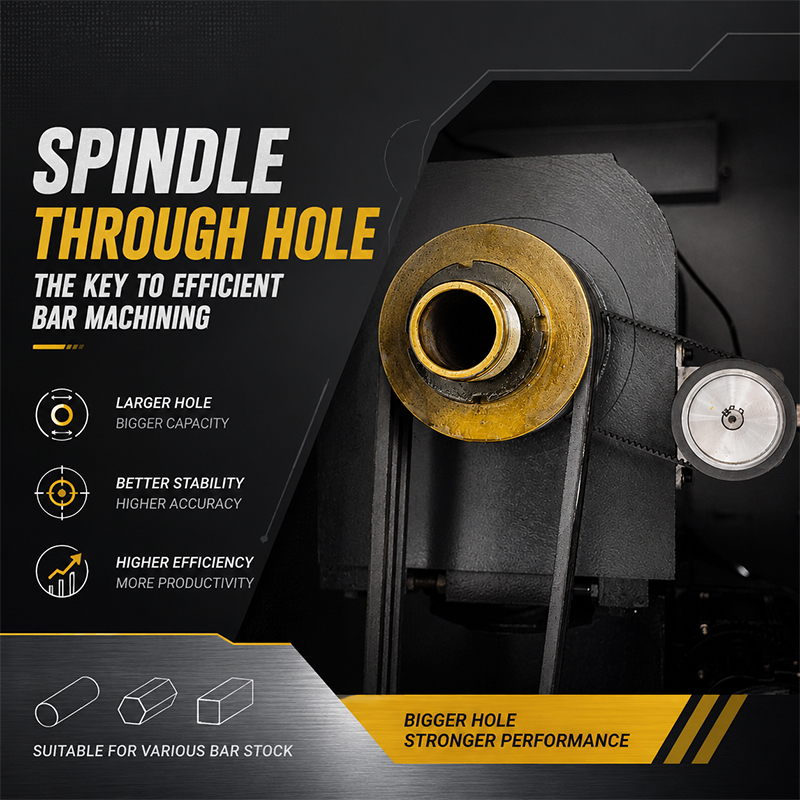
How to choose the spindle through-hole?
The spindle through-hole refers to the diameter size of the hole inside the spindle of a CNC lathe that allows bar stock to pass through. It determines the maximum diameter of the bar stock that can pass through the spindle and is also one of the important parameters measuring the machining capability of the CNC lathe.
In actual production, bar stock is usually fed into the spindle by an automatic feeder and then clamped by the chuck to complete continuous machining. Only when the bar stock diameter is less than or equal to the spindle through-hole size can it smoothly enter the spindle to achieve continuous feeding.
For example, a CNC lathe with a spindle through-hole of 52mm is generally suitable for machining bar stock with a diameter not exceeding about 50mm; while equipment with a spindle through-hole of 82mm or 105mm can process larger specifications of bar stock, meeting the production needs of heavy machinery, petroleum equipment, and large shaft parts.
Therefore, the spindle through-hole is not only a technical parameter but also directly determines the applicable range of the equipment.
For enterprises using automatic feeding production methods, the spindle through-hole almost determines the working efficiency of the entire production line.
When the bar stock can smoothly pass through the spindle, the feeder can continuously supply raw materials, and the machine tool completes turning, grooving, drilling, tapping, and other processes according to the program, achieving long-term continuous machining.
If the bar stock diameter exceeds the spindle through-hole, even if the machine tool has excellent other performance, automatic feeding cannot be realized, and only single-piece clamping machining can be used. This not only increases manual operation time but also reduces equipment utilization.
Especially in the mass production of automotive parts, hydraulic fittings, hardware accessories, and standard shaft parts, automatic feeding can significantly reduce downtime and improve production efficiency, making the spindle through-hole an important reference indicator when enterprises purchase equipment.
The closer the spindle through-hole is to the diameter of the bar stock, the higher the material utilization and feeding efficiency usually are.
For example, a company that has been processing shaft parts with a diameter of 45mm for a long time, if it chooses equipment with a spindle bore of only 46mm, although it can complete the processing, the feeding process is easily restricted by the clearance, requiring higher material quality.
If a model with a 52mm spindle bore is chosen, the feeding will be smoother, the equipment will run more stably, effectively reducing feeding failures and improving continuous processing efficiency.
On the other hand, when a company plans to increase larger-sized products in the future, appropriately reserving the spindle bore size can also avoid premature equipment obsolescence and provide more space for the company's subsequent development.
Therefore, under the premise of ensuring reasonable costs, choosing a spindle bore slightly larger than the actual bar diameter is usually a more scientific solution.

Many customers believe that since the spindle bore affects the processing range, choosing a larger spindle bore is more cost-effective.
In fact, this is not the case.
The larger the spindle bore, the higher the requirements for the overall spindle structure, bearing size, and machine rigidity. For companies that process small-diameter parts for a long time, an excessively large spindle bore not only increases procurement costs but may not bring higher processing efficiency.
For example, a company that processes small shafts around 20mm in diameter for a long time choosing equipment with a 105mm spindle bore is clearly a waste of resources. Reasonably matching product size and equipment specifications can achieve the best return on investment.
Therefore, when purchasing equipment, companies should comprehensively consider current product sizes and future product plans, rather than simply pursuing larger parameters.
Different processing industries have obvious differences in their spindle bore requirements.
The automotive parts industry processes a large number of shafts, flanges, and connectors, usually choosing spindle through-holes ranging from 52mm to 66mm to meet most product requirements.
The hydraulic industry often processes thick-walled steel pipes, cylinder joints, and hydraulic valve bodies, requiring relatively larger through-hole sizes; some companies prefer configurations of 82mm or even larger.
Petroleum machinery, construction machinery, and large transmission shaft manufacturers need to process thicker bar materials, so they typically choose CNC lathes with through-holes larger than 105mm to meet the production demands of heavy-duty parts.
In contrast, industries such as hardware processing, instrumentation, and electronic components have smaller product sizes, so medium and small spindle through-hole specifications can meet processing needs while balancing equipment cost and processing efficiency.
Modern CNC lathes are increasingly equipped with automatic feeders to achieve continuous processing and unattended production. Whether the automatic feeding system can operate stably largely depends on the spindle through-hole size.
When the bar stock matches the spindle through-hole size reasonably, the feeding process is smoother, feeding speed is more stable, material vibration is reduced, and machining dimensional consistency is higher.
If the spindle through-hole is too small, the bar stock cannot pass smoothly, which not only affects automatic feeding but may also increase equipment failure rates; if the through-hole is too large and the bar stock is thin, it may cause increased vibration at high speeds, so proper matching of guide bushings and feeding systems is necessary.
Therefore, when planning an automated production line, the spindle through-hole, feeder, and bar stock specifications should be designed as an integrated solution rather than considering any single component separately.
For enterprises, when selecting a spindle through-hole, priority should be given to the actual products being processed rather than blindly pursuing larger sizes.
If a company processes bar stock below 40mm for a long time, a CNC lathe with a spindle through-hole around 52mm can be chosen; if product diameters mainly range from 60mm to 80mm, an 82mm through-hole configuration is recommended; for large shafts and heavy machinery parts, the spindle through-hole should be selected based on bar stock size, such as 105mm or even larger.
At the same time, a comprehensive evaluation should be conducted considering automatic feeding requirements, future product upgrade plans, and budget. This ensures current production efficiency while meeting future expansion needs.

Although the spindle through-hole is just one of many technical parameters of CNC lathes, it directly affects bar stock processing capability, automatic feeding efficiency, and equipment applicability. Choosing the right spindle through-hole can not only improve processing efficiency but also reduce manual intervention, enhance equipment automation, and bring higher production benefits to enterprises.
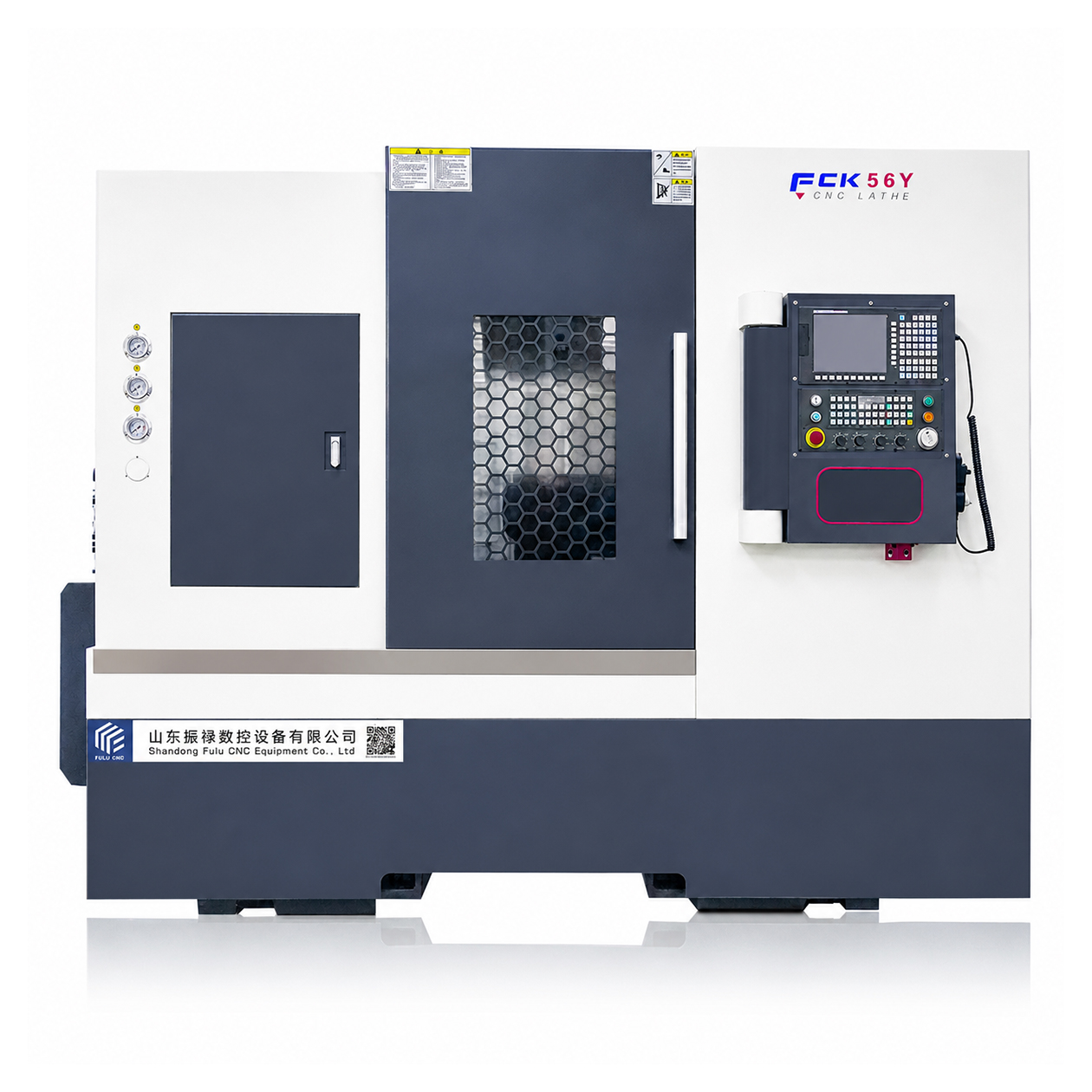
As a professionalCNC machine tool manufacturerFULUCNC offers various spindle through-hole configurations based on different customer processing needs, including specifications such as 52mm, 66mm, 82mm, 105mm, and supports various automation configurations like hydraulic chucks, pneumatic chucks, and automatic feeders.
If you are purchasing a CNC lathe and are unsure which spindle through-hole is more suitable for your products, please contact us. Our technical team will recommend more reasonable equipment configurations and automation solutions based on your bar stock specifications, processing technology, and production requirements to help you achieve more efficient and stable metal processing production.


Plsease input value
Plsease input value
Plsease input value
Plsease input value
Plsease input value
